

Andy Baldassarre | BG Director of Marketing and Training
In the world of fixed operations, few services sit in the sweet spot between value to the customer and profitability for the shop like transmission and driveline maintenance. Yet despite their long-term importance, these services remain two of the most undercommunicated offerings in many service departments.
Whether you’re a fixed operations director, service manager, or service advisor, understanding how to position transmission and driveline services isn’t just about technical knowledge; it’s about educating customers, earning their trust, and creating a predictable stream of revenue for your department while helping customers protect their vehicles.
The best practice is to know what the manufacturer’s recommendations are, and then train your team to focus on driving conditions and fluid condition as the real triggers for service.

Why Transmission and Driveline Maintenance Matters
To start, it’s critical that your team fully understands the “why” behind these services. High-quality transmission and differential fluids, as well as driveline gear oils, go beyond simple lubrication. They actively prevent deposit buildup, enhance oxidation and thermal stability, and supply the limited-slip protection necessary for optimal drivetrain performance and longevity.
Over time, fluid degrades due to heat, pressure, and contamination. This can lead to reduced performance, sluggish shifting, gear whine, and eventual severe internal wear or failure. Most consumers are unaware that these systems can fail prematurely without routine fluid replacement; and when it happens, repairs run high.
By maintaining these fluids at regular intervals, you’re not only preventing catastrophic repairs, you’re also preserving the vehicle’s performance, fuel efficiency, and resale value. For the customer, it’s a matter of protecting their investment. For the dealership, it’s about offering peace of mind through high-value services that build loyalty and drive revenue.
Service Intervals: What to Know and How to Communicate It
Many vehicle manufacturers now promote “lifetime fluids”—a term that typically means the lifetime of the fluid as covered under warranty, as opposed to the lifetime of the vehicle. Still, industry experience shows that under such real-world driving conditions as stop-and-go traffic, extreme temperatures, towing, and off-roading, transmission and differential fluids should typically be changed between 30,000 and 60,000 miles. In fact, many OEMs include drivetrain fluid changes in their recommended maintenance schedules, particularly for vehicles with all-wheel drive or those used under severe conditions.
Your service advisors should be comfortable explaining these nuances. The best practice is to know what the manufacturer’s recommendations are, and then train your team to focus on driving conditions and fluid condition as the real triggers for service.
Most consumers are unaware that these systems can fail prematurely without routine fluid replacement; and when it happens, repairs run high.
Best Practices for Presenting the Service to Customers
- Keep It Visual
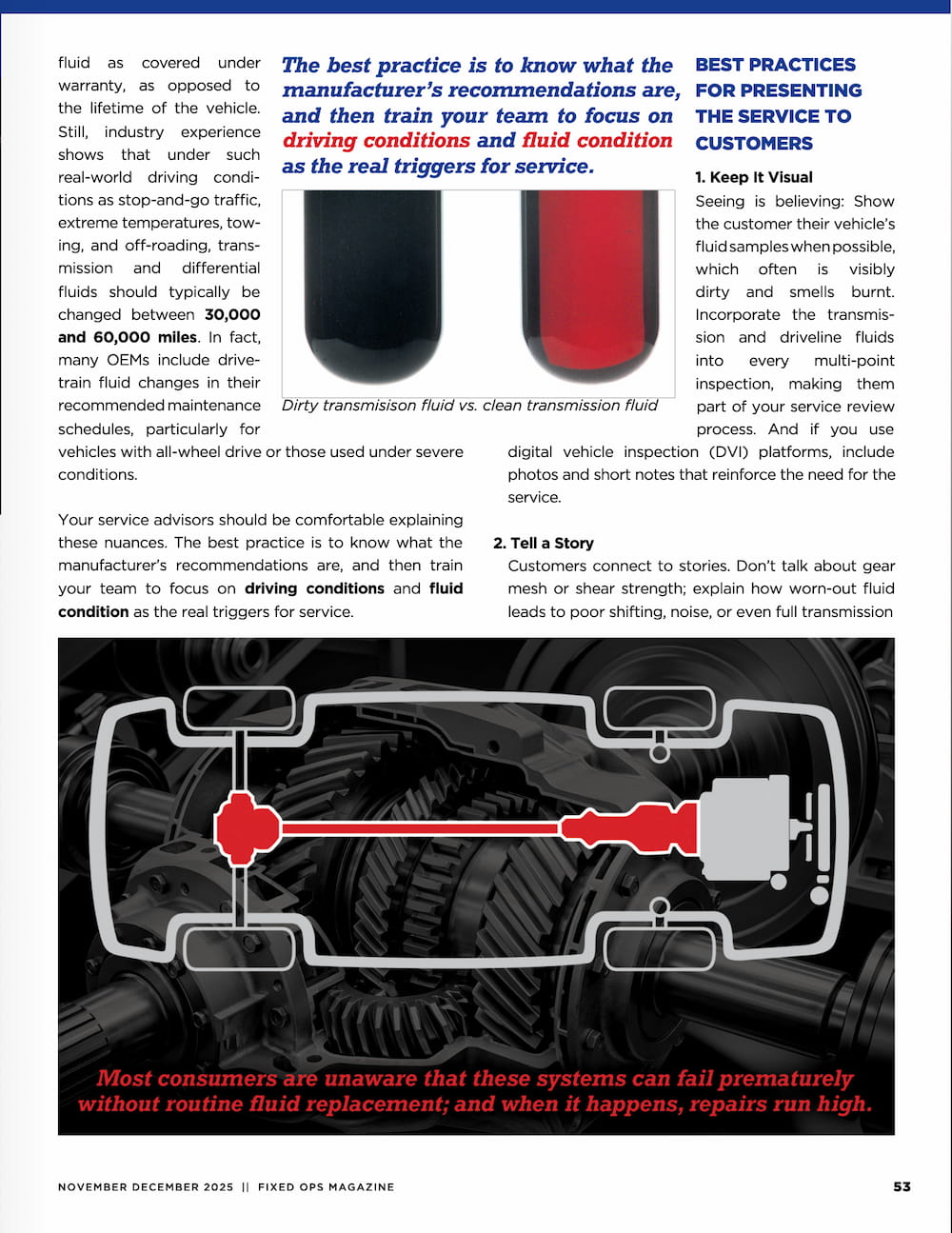
Seeing is believing: Show the customer their vehicle’s fluid samples when possible, which often is visibly dirty and smells burnt. Incorporate the transmission and driveline fluids into every multi-point inspection, making them part of your service review process. And if you use digital vehicle inspection (DVI) platforms, include photos and short notes that reinforce the need for the service. - Tell a Story
Customers connect to stories. Don’t talk about gear mesh or shear strength; explain how worn-out fluid leads to poor shifting, noise, or even full transmission replacement. Share real-life examples of customers who delayed the service and faced major repairs later. - Focus on Prevention, Not Panic
Don’t use fear as a selling point. Instead, position the service as an investment in longevity and performance: “This is part of the preventive maintenance that helps avoid future issues. It’s like getting an oil change for your transmission.” - Bundle for Value
Consider packaging transmission and differential services with other drivetrain-related maintenance (e.g., transfer case or AWD inspections) or promoting it during tire rotations and brake checks. Bundling creates value and increases service penetration. - Leverage Seasonal Selling
Fall and spring are great times to recommend drivetrain services, especially in regions with extreme temperatures. Tie the service to road trips, weather changes, or towing season—times when drivetrain stress is at its peak.

The Profitability Perspective
From a business standpoint, transmission and driveline services represent a high-margin opportunity with relatively low parts and labor costs. Because these time-based services require minimal diagnosis, technician training is simplified and scheduling is predictable, so service processes become more consistent.
Even better? They contribute to customer retention. When a customer sees that your shop is proactively protecting their investment, they’re more likely to return, trust your recommendations, and refer to friends and family. Their loyalty is worth far more than a one-time upsell.
Additionally, tracking your drivetrain service penetration rate (i.e., the percentage of eligible vehicles that receive the service) can serve as a robust KPI for both service advisors and shop performance. Shops that effectively implement these services see an increase in dollars per repair order and customer satisfaction scores.
Final Thoughts: Sell the System, Not the Service
Ultimately, the key to success isn’t just in offering the service, it’s in positioning it as part of a comprehensive vehicle health plan. When customers see your service department as a place that prioritizes the long-term reliability of their vehicle, they’re more likely to say “yes” today—and come back tomorrow.
Equip your team with the right knowledge, language, and tools. Make transmission and driveline services part of your shop’s culture, not just your menu. Do that, and you’ll turn one of the industry’s most overlooked services into one of your most reliable revenue streams.

About the Author
Andy Baldassarre leads the marketing and training departments for BG Products, Inc. He has more than 23 years of experience in the automotive industry with an emphasis on adult learning in the automotive workplace.