

Andy Baldassarre | BG Director of Marketing and Training
Beyond Year 3: A Retention Strategy
Every dealership tracks warranty penetration. Few track what happens afterward.
One of the most revealing conversations I’ve had this year with a fixed operations director began with a simple statement: “We dominate warranty for the first three years. After that, we lose people.”
Across the country, dealerships see the same pattern: strong service retention while vehicles are under factory coverage, then a steady drop as customers transition out of warranty and into customer-pay ownership.
That drop isn’t inevitable. But it is predictable.
To improve fixed ops performance, address what happens between warranty expiration and vehicle trade-in.
The Warranty Comfort Zone
Warranty work provides structure. Customers return because they believe:
- The repair is covered.
- The dealership is the authority.
- The cost is controlled.
Little friction exists during those first years of ownership. The vehicle is new, and service intervals are light. The customer trusts the brand.
Then, Year 3 or 4 arrives.
The vehicle is still reliable. But now, maintenance and repairs are no longer manufacturer-subsidized—they’re customer decisions.
Many dealerships lose control of the relationship.
Why Customers Defect Post-Warranty
It’s rarely about price alone. It’s about perceived value. Customers leave after warranty because:
- They don’t understand the value of a brand-certified technician.
- They weren’t introduced to a maintenance mindset.
- They see the dealership as a “warranty provider,” not a life-cycle partner.
- They weren’t given a structured post-warranty path.
In other words, the dealership did not transition the relationship. The service drive treated the first three years as transactions and then expected loyalty in Year 4. Loyalty doesn’t work that way.
The Financial Impact
For fixed operations directors, this isn’t just a customer experience issue. It’s a profitability issue.
Consider this: A customer who consistently brings their vehicle in for service during years four through seven represents thousands of dollars in customer-pay revenue.
Multiply that by hundreds of vehicles leaving your retention funnel each year. Post-warranty attrition quietly erodes gross profit and service absorption coverage.
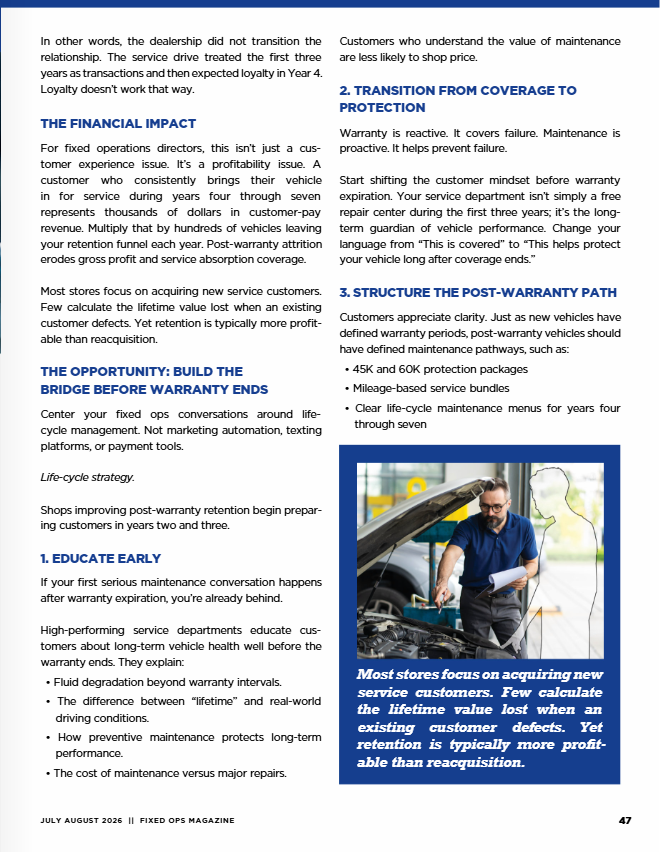
Most stores focus on acquiring new service customers. Few calculate the lifetime value lost when an existing customer defects. Yet retention is typically more profitable than reacquisition.
The Opportunity: Build the Bridge Before Warranty Ends
Center your fixed ops conversations around life-cycle management.
Not marketing automation, texting platforms, or payment tools.
Life-cycle strategy.
Shops improving post-warranty retention begin preparing customers in years two and three.

Most stores focus on acquiring new service customers. Few calculate the lifetime value lost when an existing customer defects. Yet retention is typically more profitable than reacquisition.
- Educate Early
If your first serious maintenance conversation happens after warranty expiration, you’re already behind.
High-performing service departments educate customers about long-term vehicle health well before the warranty ends. They explain:
- Fluid degradation beyond warranty intervals.
- The difference between “lifetime” and real-world driving conditions.
- How preventive maintenance protects long-term performance.
- The cost of maintenance versus major repairs.
Customers who understand the value of maintenance are less likely to shop price.
- Transition From Coverage to Protection
Warranty is reactive. It covers failure.
Maintenance is proactive. It helps prevent failure.
Start shifting the customer mindset before warranty expiration. Your service department isn’t simply a free repair center during the first three years; it’s the long-term guardian of vehicle performance. Change your language from “This is covered” to “This helps protect your vehicle long after coverage ends.”
- Structure the Post-Warranty Path
Customers appreciate clarity. Just as new vehicles have defined warranty periods, post-warranty vehicles should have defined maintenance pathways, such as:
- 45K and 60K protection packages
- Mileage-based service bundles
- Clear life-cycle maintenance menus for years four through seven
Customers who see a roadmap are less likely to leave it. Leave them to figure it out alone, and they’ll shop around.
- Reinforce Confidence With Protection Programs
Confidence drives retention.
A powerful retention driver in fixed ops is offering protection that extends beyond the transaction. When customers know that services are backed by additional protection, they’re less likely to hesitate and more likely to trust your service department.
They know that you stand behind your work and are invested in their vehicle’s future.
- Measure What Matters
-
- Year 4 retention rates
- Service frequency after warranty expiration
- Maintenance acceptance on post-warranty vehicles
- Return visits tied to previous protection programs
The Advisor’s Role in Retention
Service advisors aren’t repair-order writers. They’re relationship managers.
When advisors explain services clearly, present structured maintenance options, reinforce long-term protection, and follow up on declined recommendations, they shift from transactional selling to relationship building.
Training advisors to have life-cycle conversations, not just visit-based conversations, is one of the highest ROI investments a store can make.
The Bigger Picture: Service Drives Sales
A direct correlation exists between service retention and future vehicle purchases.
Customers who service consistently at the dealership are more likely to:
- Trust the brand.
- Return to the same store.
- Purchase their next vehicle from you.
When a service customer defects after warranty, you’re risking future sales opportunities plus maintenance revenue.
Post-warranty retention protects both fixed ops and variable operations.
Final Thoughts
Warranty years are comfortable, predictable, structured, and manufacturer-supported.
But the real test of your service department begins when warranty ends.
If customers see your dealership as a temporary provider of covered repairs, they’ll leave when coverage expires. If they trust you to maintain their vehicle’s performance, they’ll stay.
Winning dealerships don’t simply dominate warranty. They successfully retain customers long after the warranty coverage ends.

About the Author
Andy Baldassarre leads the marketing and training departments for BG Products, Inc. He has more than 25 years of experience in the automotive industry with an emphasis on adult learning in the automotive workplace.