



BG TFX Transmission Fluid Exchanger
U.S. PATENT PENDING
PN E101-7000
INSTRUCTIONS


IMPORTANT! The following instructions must be read and understood before attempting to use the BG TFX Transmission Fluid Exchanger. Read Product Safety Data Sheet before handling any BG product. Make sure this service is performed in a well-ventilated area. The BG TFX is designed to service transmissions with line pressure up to 100 PSI maximum, and is for use with BG products described in these instructions only. The use of any other chemicals or fluids with this system will void all warranties and could create hazardous conditions.
- Caution: Heavy object. Consider mechanical aid or at least a three-person team lift when lifting machine.
- Before handling any chemical, read its Material Safety Data Sheet.
- Wear safety goggles to protect your eyes.
- Wear Nitrile®, Neoprene®, or PVC gloves to protect your hands.
- Wear a long-sleeved shirt.
- A combination of mechanical and local ventilation should be used to prevent operator exposure to noxious fumes.
- Keep all hoses and tools away from moving engine parts.
- Check all lines and fittings for cracks and leaks before and after service.
- Caution: Slip hazard. Use EXTREME CAUTION when removing transmission lines and/or adaptors before and after service. Transmission fluid may be pressurized and can eject unexpectedly. Leaked fluid can accumulate on floors or surfaces, creating slip hazards that increase the risk of falls and secondary injuries.
- Caution: Vehicle and machine components can be extremely hot during and after services. Always use extreme caution and wear proper PPE. Be very careful in handling connections because they will also be very hot.
- Always ensure caps on the New Transmission Fluid Fill Port (F1) and Additive Funnel (F2) are in place during machine operation.
- The BG TFX is designed to service transmissions with line pressure up to 100 PSI maximum and is for use with BG products described in these instructions only. The use of any other chemicals or fluids with this system will void all warranties and could create hazardous conditions.
- Ensure that the BG TFX Service Selector (V1) is in the “OFF” (O) position before connecting to shop air.
- If vehicle is lifted and cycling through gears, ensure tires are not touching any surface.
- Handle all used transmission fluid in accordance with federal, state, and local regulations.
- Caution: Operator can lose control of the machine while moving on uneven or inclined surfaces, risking the machine tipping over and causing injury to personnel or damage to property.
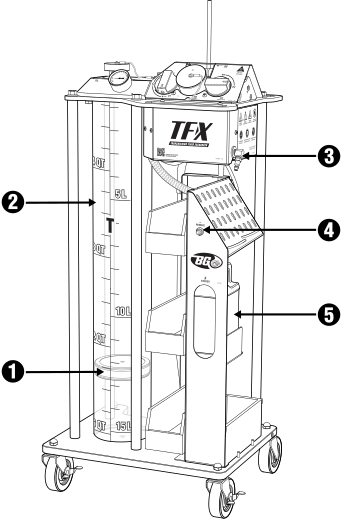
- Puck
- Transmission Fluid Tube (T)
- Air Supply
- Remove Fluid Button (–)
- Excess Fluid Container (X)
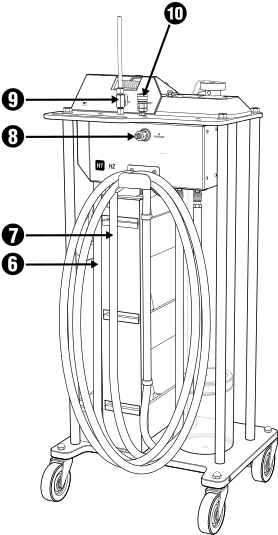
- Marked Service Hose (H1)
- Unmarked Service Hose (H2)
- Recharge Port (R)
- BB02 Dispensing Wand
- BB01 Recharge Adaptor
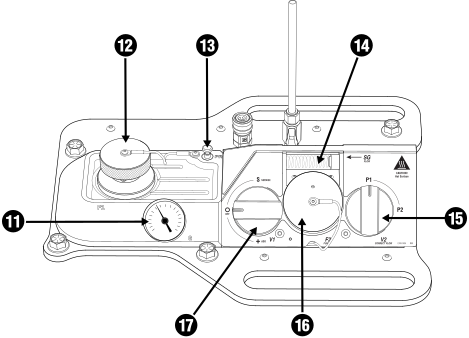
- Pressure Gauge (G)
- New Transmission Fluid Fill Port (F1)
- Pressure Release (PR)
- Sight Glass (SG)
- Correct Flow Knob (V2)
- Additive Funnel (F2)
- Service Selector (V1)
Initial Setup and Charging (Filling)
- Unpack system and check for shipping damage, missing parts, and components.
- Install bins as shown in drawing.
- Place BB01 Recharge Adaptor and BB02 Dispensing Wand in labeled holes on top plate.
- For initial charging (filling) of the machine:
- Turn the Service Selector (V1) to “OFF” (O). Turn Correct Flow Knob (V2) to “P2”. Attach BB02 Dispensing Wand, or any open-end adaptor, to the end Marked Service Hose (H1). The adaptor opens the valve in the quick coupling to allow used fluid to flow out. Expect only a small amount of air/fluid during initial filling.
- Attach BB01 Recharge Adaptor to the Recharge Port (R) on the back panel of the BG TFX. Be sure the service hose with the open-ended adaptor is secure. Apply air pressure to the BB01 Recharge Adaptor. The Transmission Fluid Tube (T) should pressurize to approximately 45 PSI and the used transmission fluid will start flowing out the service hose. Once the used fluid is removed, disconnect the air supply and press the Pressure Release (PR) on the fill block until the Pressure Gauge (G) reads “0”. Continue holding the pressure release for an additional five seconds to ensure there is no residual pressure.
- This procedure ensures the Puck is all the way at the bottom of the Transmission Fluid Tube (T).
- Be sure the Pressure Gauge reads zero and remove the cap from the New Transmission Fluid Fill Port (F1). Pour approximately four gallons (15 Liters) of the appropriate transmission fluid into the fill port. Keep filling until fluid is just over the strainer and a full stream of fluid is visible flowing into the Excess Fluid Container (X). This procedure ensures that the system is full and all trapped air has been removed.
- Allow fluid level to drain down to the mesh strainer and replace the cap (F1).
- Remove the BB01 Recharge Adaptor. Remove the BB02 Dispensing Wand or open-end adaptor from the service hose (H1 or H2).
The BG TFX is now ready for service.
Operating Instructions
IMPORTANT! The BG Transmission Service is a maintenance service, not a repair service! A thorough inspection of the transmission, including lines and coolers, should be performed and all repairs made before performing this service. Check the vent on top of the transmission to be sure it is open and functioning. Inspect seal areas and gaskets, and replace any that are leaking or badly deteriorated. If the pan gasket needs replacing, it is recommended that the transmission filter be replaced as well. The filter should be changed anytime the pan is removed. Check hoses, metal lines, and connections to ensure all are in good repair.
- Start the vehicle’s engine and run until normal operating temperature is reached.
- Check transmission fluid level. If it is more than 32 oz. (946 mL) low, add fluid, but leave room for 11 oz. (325 mL) of BG Quick Clean for Transmissions, PN 106. Do not overfill transmissions.
- Shut off engine and locate a junction in either of the two transmission lines that will allow you to install one of the included adaptors to each end of the junction. See “Possible Points to Make Connections” in this manual. Separate the line at the chosen junction and attach adaptors. Use pinch off clamps on rubber lines to prevent transmission fluid loss while connections are being made.
NOTE: Some vehicles also use the radiator to help cool the engine oil. Be sure the lines you are working with actually go to the transmission and not the engine! - Press and hold the Pressure Release (PR) button on the fill block of the BG TFX to be certain that there is no pressure in the machine.
- Connect BG TFX service hoses (H1 and H2) to adaptors. Either hose can be attached to either adaptor—flow direction will be corrected after the vehicle’s engine is started.
Caution: If the vehicle is on a lift, ensure no equipment, tools, or personnel are underneath before lowering the vehicle. When raising the vehicle ensure machine is close and hoses are free of kinks. - Turn the Service Selector (V1) to “OFF” (O) and connect the machine to shop air. Start the vehicle’s engine and check for leaks.
- Determine flow direction through the Sight Glass (SG); flow should be in the direction of the flow arrow. Correct flow direction, if required, using the Correct Flow Knob (V2) by turning the Correct Flow Knob (V2) 90°.
Caution: Service Selector (V1) must remain in “OFF” (O) position until flow direction has been corrected. - Add the contents of one 11 oz. (325 mL) can of BG Quick Clean for Transmissions, PN 106, into the Additive Funnel (F2). Turn the Service Selector (V1) to the “ADD” (+) position to draw in cleaner. Run the pump until fluid is drawn in, plus an additional 15 seconds to ensure the fluid ends up in the vehicle. Set the Service Selector (V1) back to “OFF” (O).
- The vehicle should then idle for 15 minutes. With the engine running, shift the transmission through all the gears so the valve body in the transmission is actuated to ensure BG Quick Clean gets to all parts. During this procedure, make sure the brake is fully applied and drive wheels have stopped turning between gear changes to prevent damage to transmission or differential assemblies. After adding BG Quick Clean, the vehicle should not be run more than 30 minutes before performing the transmission fluid exchange.
NOTE: If the vehicle cannot be placed on a lift, chock the wheels, apply brakes (including parking brake) and carefully shift transmission through the gears several times with engine running at idle speed.
Vehicle is now ready for the transmission fluid exchange. - With the engine still running, turn Service Selector (V1) to “SERVICE” (S). The transmission’s own pump along with the diaphragm pump in the machine will begin the exchange immediately by pumping new fluid into the vehicle and extracting used transmission fluid from the vehicle. The used fluid from the vehicle is transferred into the bottom of the Transmission Fluid Tube (T) at the same rate that the new fluid exits the top and returns to the vehicle. This means that the level of fluid in the transmission and components remains the same at all times during the exchange. The fluid level in the transmission does not require monitoring. For best results, the operator should be inside the vehicle shifting the transmission through its gears as in step 9 to ensure that all cleaner and used transmission fluid is purged from the valve body. As the transmission continues to pump used transmission fluid into the Transmission Fluid Tube (T), the Puck moves to the top of the machine to complete the exchange. A preset bypass valve will open after a pressure differential exists between the new and used transmission fluid lines. This will route the incoming fluid around the Transmission Fluid Tube (T) and into the transmission. The exchange is complete when the gauge pressure drops and/or the diaphragm pump sound changes.
NOTE: The BG TFX contains a diaphragm booster pump that can speed up the exchange on low-pressure, low-flow transmissions. The service can be performed without boost by disconnecting the machine from shop air for the exchange. Shop air is required for the machine’s additive function to work. - When the fluid exchange is complete, add 11 oz. (325 mL) of BG ATC Plus, PN 310, or BG CVT Plus, PN 303, to the Additive Funnel (F2). With the engine running, turn the Service Selector (V1) to “ADD” (+). Run the pump for 15 seconds after fluid is drawn in to ensure it makes it to the vehicle.
- Check the level of transmission fluid in the transmission and adjust accordingly. The BG TFX has the ability to add and remove additional transmission fluid with the vehicle’s engine running. Pour the desired amount of fluid into the Additive Funnel (F2) and turn the Service Selector (V1) to “ADD” (+). Run the pump for approximately 15 seconds after fluid is drawn in to ensure the fluid ends up in the vehicle. Set the Service Selector (V1) to “OFF” (O). To remove fluid, press and hold the Remove Fluid Button (–) on the BG TFX tower until the desired amount is removed into the Excess Fluid Container (X).
- Shut off engine and press and hold the Pressure Release (PR) to remove any pressure trapped in the system. Remove adaptors and reconnect transmission fluid lines. Service is complete.
Recharging
The Transmission Fluid Tube (T) in the BG TFX must be recharged with new transmission fluid before the next service. This recharging process will empty all the used fluid, and fill the machine with new fluid. This ensures it is ready to complete the next service.
Do not attempt to apply air or fluid pressure to the service hoses because these are not regulated and the system will be damaged.
- To remove used fluid, set the Service Selector (V1) to “OFF” (O), Correct Flow Knob (V2) to “P2”, and attach the BB01 Recharge Adaptor to the Recharge Port (R) on the back panel of the BG TFX. Attach the BB02 Dispensing Wand to Marked Service Hose (H1) and place the end into a used oil receptacle.
Note: If Correct Flow Knob (V2) is in the incorrect position or incorrect service hose, recharge may be slower. - Ensure the ball valve on the BB02 Dispensing Wand is closed and connect shop air into the BB01 Recharge Adaptor on the Recharge Port (R). Slowly open the ball valve on the BB02 Dispensing Wand and drain the Transmission Fluid Tube (T) until the Puck reaches the bottom and all used fluid is removed. Remove the air supply and press and hold the Pressure Release (PR) on the fill block until the Pressure Gauge (G) reads “0”.
- Next, remove the cap from the New Transmission Fluid Fill Port (F1) from the fill block and add four gallons (15 Liters) of the appropriate new transmission fluid. Pour transmission fluid into the New Transmission Fluid Fill Port (F1) until a solid stream of fluid flows over the strainer and into the Excess Fluid Container (X). This signals that the system is completely full and there is no air in the system. Allow transmission fluid to drain to the bottom of the overflow and replace the Fill Cap (F1). The excess transmission fluid captured in the Excess Fluid Container (X) is new and can be used for top off or it can be put back into the new transmission fluid source container.
- Remove the BB01 Recharge Adaptor from the Recharge Port (R) and return to its storage location. Remove the BB02 Dispensing Wand from the service hose and return to its storage location.
- Remove Excess Fluid Container (X) and handle fluid per state and federal regulations. Reinstall (X).
Recharging is complete. The BG TFX is now ready for the next service.
Purging New Transmission Fluid
The following procedure applies to removing new transmission fluid from a fully charged BG TFX. This is necessary to charge the machine with a different transmission fluid or to empty the BG TFX for maintenance.
- Press and hold the Pressure Release (PR) on the fill block to remove any residual pressure.
- Attach open-ended adaptors to the end of both service hoses (H1 and H2) and place ends into appropriate receptacle.
- Turn Service Selector (V1) to “OFF” (O), Correct Flow Knob (V2) to “P1”, and connect the machine to shop air.
- Turn Service Selector (V1) to “SERVICE” (S). The new fluid will be pumped out of the Marked Service Hose (H1). Unmarked Service Hose (H2) must be able to draw in air for purge to work properly. Depending on the condition of the machine, air and transmission fluid might be exhausted during this step.
- Once all new fluid is removed, turn the Service Selector (V1) back to “OFF” (O) and disconnect the air supply from the machine. The BG TFX is now empty of new fluid and needs to be recharged and filled with the appropriate transmission fluid.
Performing Lower Volume Service
The BG TFX can be set up to perform a lower volume service by following the instructions below.
Note: The TFX must be full of fluid before it is connected to a vehicle. If the machine is not completely full of fluid, it will leave the vehicle level high or low. Do not attempt to apply air or fluid pressure to the service hoses because these are not regulated and the system will be damaged.
This process requires the machine to be full of used fluid (from a previous service).
- Determine the amount of fluid that is required for the next service. This is the amount of used fluid that will be removed.
- To remove used fluid, set the Service Selector (V1) to “OFF” (O), Correct Flow Knob (V2) to “P2”, and attach the BB01 Recharge Adaptor to the Recharge Port (R) on the back panel of the BG TFX. Attach the BB02 Dispensing Wand to Marked Service Hose (H1) and place the end into a used oil receptacle.
Note: If Correct Flow Knob (V2) is in the incorrect position or incorrect service hose used, recharge may be slower. - Ensure the ball valve on the BB02 Dispensing Wand is closed and connect shop air into the BB01 Recharge Adaptor on the Recharge Port (R). Slowly open the ball valve on the BB02 Dispensing Wand and drain the Transmission Fluid Tube (T) until the top of the puck reaches the desired service amount, shut the ball valve on the BB02 Dispensing Wand at this point. Remove the air supply and press and hold the Pressure Release (PR) on the fill block until the Pressure Gauge (G) reads “0”.
- Next, remove the cap from the New Transmission Fluid Fill Port (F1) from the fill block and fill the machine with the appropriate new transmission fluid. Pour transmission fluid into the New Transmission Fluid Fill Port (F1) until a solid stream of fluid flows over the strainer and into the Excess Fluid Container (X). This signals that the system is completely full and there is no air in the system. Allow transmission fluid to drain to the bottom of the overflow and replace the Fill Cap (F1). The excess transmission fluid captured in the Excess Fluid Container (X) is new and can be used for top off or it can be put back into the new transmission fluid source container.
- Remove the BB01 Recharge Adaptor from the Recharge Port (R) and return to its storage location. Remove the BB02 Dispensing Wand from the service hose and return to its storage location.
- Remove Excess Fluid Container (X) and handle fluid per state and federal regulations. Reinstall Excess Fluid Container (X).
Recharging is complete. The BG TFX is now ready for the next service.
Decommissioning Machine
This recommendation outlines the proper method for decommissioning and recycling the BG TFX transmission machine at the end of its service life. Once the unit is no longer functional due to excessive wear or outdated technology, it should be safely taken out of service. Though built with durable components like manifolds, support rods, and top and bottom plates, these parts must be retired when they no longer meet operational standards.
Before disassembly, all used transmission fluid must be properly drained and disposed of in accordance with federal, state, and local regulations. BG recommends dismantling the machine to recover recyclable components. To reduce environmental impact, reusable metals and parts should be sent to certified recycling facilities for refurbishment or material recovery.
Possible Points to Make Connections
(Note: It is only necessary to disconnect one line.)
CAUTION: Be sure the line is a transmission fluid line and not an engine oil line!
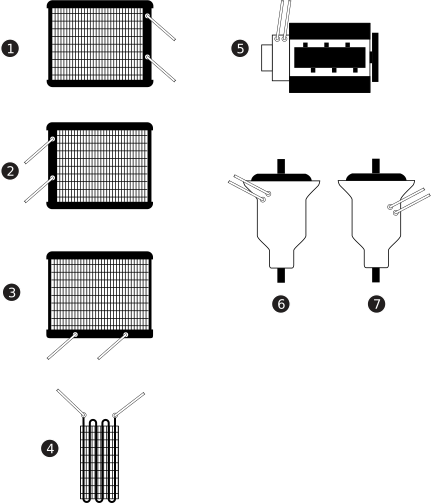
- Crossflow radiator with transmission fluid cooler on side
- Crossflow radiator with transmission fluid cooler on opposite side
- Top tank with transmission fluid cooler on bottom
- External transmission fluid cooler
- Transmission front wheel drive
- Transmission rear wheel drive
- Transmission rear wheel drive on opposite side
Connection may be made at any accessible point along the transmission fluid route.
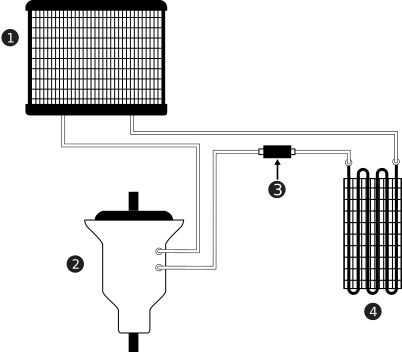
- Radiator
- Transmission
- External filter
- External cooler
Specifications
|
Metric
|
Information
|
|---|---|
|
Height: |
44.5 inches/113 cm |
|
Width: |
20.25 inches/51 cm |
|
Depth: |
16 inches/41 cm |
|
Weight: |
125 lbs/57 kg |
|
Fluid Capacity: |
4 gallons/15 Liters |
|
Maximum fluid pressure: |
100 psi/6.9 bar |
|
Maximum rated supply pressure: |
145 PSI/10 bar |
|
Construction: |
Aluminum and steel frame with heavy duty casters, fiberglass tube, steel consoles, and high temperature-, oil-, and chemical-resistant hose |
MADE IN U.S.A. with globally sourced materials.
R00
©2026 BG Products, Inc. • Wichita, Kansas • bgprod.com • MADE IN U.S.A.